Tenor Saxophone Finger Chart PDF: A Comprehensive Guide
JSON, originating from JavaScript, facilitates data exchange; finger charts, often in PDF format, are crucial for learning the tenor saxophone. These charts detail finger positions.
Understanding Tenor Saxophone Fingerings
Tenor saxophone fingerings represent the core of playing, dictating which keys to press for specific notes. Mastering these is fundamental, as they translate musical intention into audible sound. JSON, while unrelated to musical performance, highlights structured data – similarly, fingerings are a structured system.
Each fingering corresponds to a unique frequency, achieved by altering the saxophone’s internal air column. Understanding the relationship between key presses and resulting notes is paramount. PDF finger charts visually map these combinations, offering a quick reference. They often showcase alternate fingerings, providing tonal variations or facilitating smoother transitions.
Beginners often struggle with coordination, requiring diligent practice to internalize these patterns. The tenor sax’s range demands familiarity with low, middle, and high register fingerings, each presenting unique challenges. Consistent use of a chart, alongside ear training, accelerates the learning process.
The Importance of a Finger Chart
A tenor saxophone finger chart is an indispensable tool for both novice and experienced players. Much like JSON provides structure to data, a finger chart structures the complexities of the instrument. It serves as a visual roadmap, demystifying the key combinations required for each note.
Initially, memorizing fingerings can be daunting. A chart offers immediate reference, reducing cognitive load and allowing focus on embouchure and breath control. PDF format ensures accessibility and portability, enabling practice anywhere. Beyond basic notes, charts illustrate alternate fingerings, expanding tonal possibilities and improving technique.
Furthermore, a chart aids in understanding musical intervals and scales. It visually connects theory to practice, fostering a deeper comprehension of music. Consistent chart usage builds muscle memory, leading to faster, more accurate fingerings. It’s a foundational resource for unlocking the tenor sax’s full potential.

Locating a Reliable Tenor Sax Finger Chart PDF
Finding a trustworthy tenor sax finger chart PDF requires discernment, akin to validating JSON data. Numerous online resources exist, ranging from free downloads to paid options. Begin with searches targeting established music education websites or saxophone-specific forums. Beware of charts with unclear notation or inaccuracies.
Free online resources are plentiful, but quality varies. Look for charts created by experienced educators or reputable brands. Paid PDFs and apps often offer higher resolution, interactive features, and more comprehensive fingerings. Consider method books; many include detailed charts as part of their curriculum.
Prioritize charts that clearly display key positions, octave keys, and alternate fingerings. Ensure the PDF is easily readable on various devices. Cross-reference information with multiple sources to confirm accuracy. A reliable chart is a worthwhile investment in your musical journey.
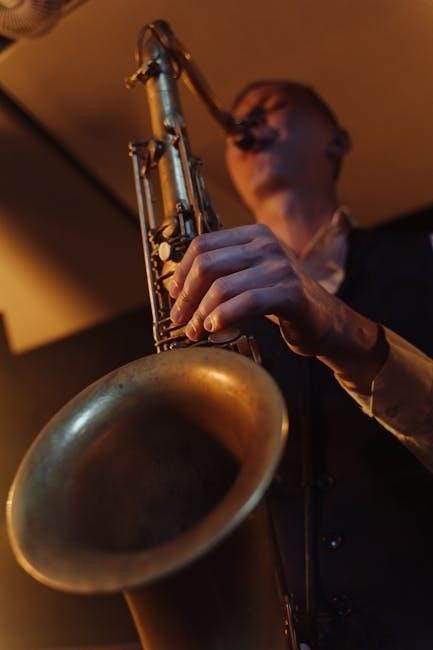
Basic Fingerings for the Tenor Sax
JSON’s structure mirrors object notation, while tenor sax fingerings build notes. Mastering fundamental finger positions—like a well-formed PDF—is essential for beginners.
Fingerings for Low Register Notes (Bb to D)
Understanding the low register is foundational for any tenor saxophone player. A reliable tenor sax finger chart PDF will visually demonstrate the initial fingerings, starting with Bb. Typically, Bb requires the left-hand index finger, along with the octave key open. Moving to A involves adding the left-hand middle finger. Ab utilizes the side keys, a common element in lower register notes.
G then introduces the left-hand ring finger, building towards F#. The chart will clearly show these incremental additions. As you progress to Eb and D, the complexity increases slightly, often involving combinations of side keys and primary fingerings. Remember, consistent practice with a PDF chart is key to memorizing these positions.
JSON-like data structures, though unrelated to music, emphasize clear organization – mirroring the need for a well-structured finger chart. Focus on clean transitions between notes, and utilize the chart to confirm accuracy. These low notes establish a solid base for more advanced playing.
Fingerings for Middle Register Notes (E to Bb)
The middle register on the tenor saxophone expands tonal possibilities, and a detailed tenor sax finger chart PDF is invaluable. E typically involves a full left-hand closure, building upon the low register fingerings. F and F# introduce subtle adjustments, often utilizing the side keys in conjunction with the primary fingerings. G, Ab, and A require precise coordination, demanding consistent practice.
As you ascend to Bb, the chart will illustrate a more complex combination of keys. Mastering these fingerings requires understanding how each key contributes to the overall pitch. Like well-formed JSON data, clarity is paramount; each fingering must be distinct and easily reproducible.
Pay attention to the octave key’s role in shifting registers. A PDF chart allows for quick reference during practice. Focus on smooth transitions and accurate intonation. These middle register notes form the core of many melodies, so proficiency is essential.
Fingerings for High Register Notes (C to F#)
Accessing the high register of the tenor saxophone demands precise embouchure control and accurate fingerings, best visualized with a tenor sax finger chart PDF. C and C# often necessitate utilizing the register key alongside a full left-hand closure and strategic right-hand adjustments. D, Eb, and E build upon these, requiring increased air support and focused embouchure.
Fingerings for F and F# in the high register can be particularly challenging, often involving alternate fingerings for optimal tone and response. Like structuring JSON for readability, clarity in fingering is vital. A good chart will clearly depict these variations.
Consistent practice with a PDF chart is crucial for developing the muscle memory needed for seamless transitions. Focus on maintaining a consistent tone and intonation as you ascend. Mastering the high register unlocks expressive possibilities, but requires dedication and attention to detail;

Advanced Fingerings and Techniques
JSON’s adaptability mirrors advanced saxophone techniques; finger chart PDFs reveal alternate fingerings, octave key mastery, and nuanced trills for skilled players.
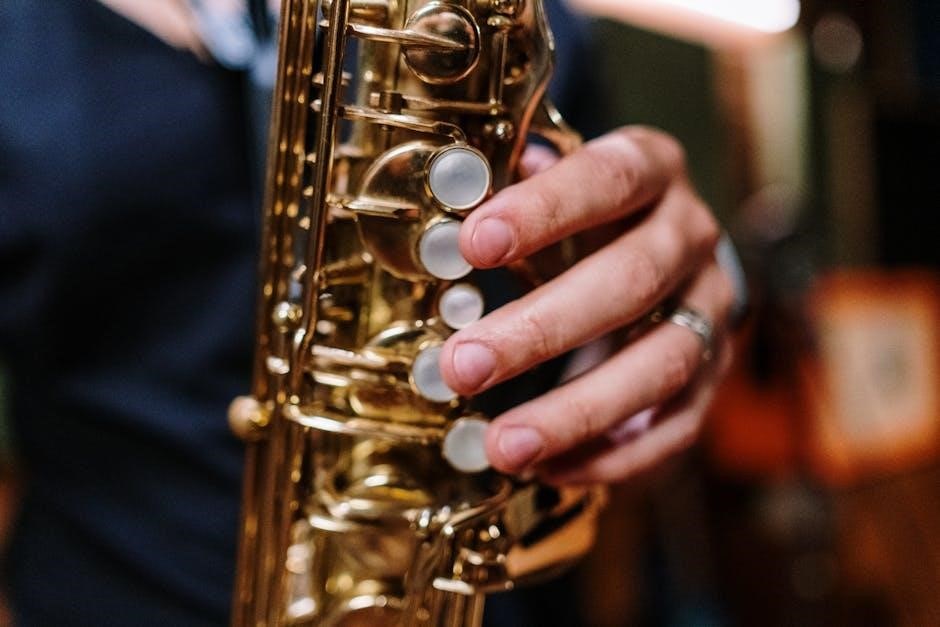
Alternate Fingerings for Improved Tone and Speed
JSON, like a complex musical score, benefits from optimized structures; similarly, tenor saxophone players utilize alternate fingerings found within finger chart PDFs to enhance performance. These aren’t errors, but deliberate choices. They offer smoother transitions between notes, particularly at faster tempos, and can dramatically improve tonal quality.
A standard fingering might require large hand movements, creating unwanted noise or slowing down execution. Alternate fingerings, detailed in comprehensive charts, often involve subtle adjustments, minimizing movement and maximizing efficiency. They can also unlock richer, more resonant tones by subtly altering the instrument’s airflow. Exploring these options, as presented in PDF resources, is crucial for developing a versatile and expressive saxophone technique. Mastering these nuances requires dedicated practice and a thorough understanding of the instrument’s mechanics, mirroring the precision needed for well-structured JSON data.
Using the Octave Key Effectively
Much like properly formatted JSON ensures data integrity, mastering the octave key on the tenor saxophone is vital for expanding your range and musical expression. Tenor sax finger chart PDFs clearly illustrate its function: pressing this key instantly transposes the note up one octave. However, effective use goes beyond simple activation.
Beginners often struggle with consistency, producing airy or unstable tones when using the octave key. Charts demonstrate proper embouchure and breath support required for a clear, focused sound. Advanced players utilize it for subtle color changes and seamless octave jumps. Understanding how the key affects airflow and resonance, as detailed in these PDF guides, is key. It’s not merely about adding a key; it’s about controlling the instrument’s response, much like carefully structuring JSON objects for optimal performance and readability.
Understanding Trills and Grace Notes Fingerings
Similar to how JSON requires precise syntax for data interpretation, executing trills and grace notes on the tenor saxophone demands accurate fingerwork. Tenor sax finger chart PDFs often dedicate sections to these ornaments, showcasing the rapid alternation between two adjacent notes for trills, and the quick, delicate touches for grace notes.
These charts aren’t just about memorizing finger combinations; they illustrate the subtle nuances of timing and pressure. A well-executed trill isn’t a mechanical repetition, but a musical flourish. Grace notes, like carefully placed comments in JSON, add character without disrupting the main flow. Mastering these techniques requires slow, deliberate practice, focusing on smoothness and clarity. The PDF guides often provide exercises to build finger dexterity and coordination, mirroring the iterative refinement process of building complex data structures.

Reading a Tenor Sax Finger Chart PDF
Tenor sax finger chart PDFs utilize symbols and notation to visually represent fingerings; understanding these is key, much like decoding JSON data structures.
Decoding the Chart Symbols and Notation
Tenor saxophone finger charts, often presented as PDF documents, employ a specific visual language to convey complex fingering information efficiently. Understanding these symbols is paramount for successful interpretation. Typically, filled circles represent keys that should be pressed, while open circles indicate keys to be left open. Different charts may utilize varying shades or colors to distinguish between primary and alternate fingerings.
The notation also includes representations of the saxophone’s keys themselves, often simplified for clarity. The octave key is usually prominently displayed, as its use dramatically alters the pitch. Charts may also incorporate symbols for techniques like the use of the side keys or the pinky keys. Just as JSON relies on specific characters for data structure, these symbols define the musical output. Recognizing these elements allows musicians to translate the visual information into accurate finger placements, ultimately producing the desired notes and tones.
Identifying Notes on the Chart
Tenor saxophone finger chart PDFs typically organize notes in a logical sequence, often mirroring the instrument’s range from low to high. Notes are commonly represented by their standard musical notation – letters indicating pitch (A, B, C, etc.) combined with ledger lines to denote octave placement. Some charts may also include the note’s frequency in Hertz (Hz) for precise reference, similar to how JSON data includes specific values.
Understanding the relationship between fingerings and the resulting notes is crucial. Charts often group fingerings by register (low, middle, high) to aid in learning. Pay attention to any symbols indicating accidentals (sharps and flats), as these require slight adjustments to the fingering. Just as identifying data types is vital in JSON parsing, recognizing the pitch and octave of each note is essential for accurate playing. Consistent practice correlating fingerings with their corresponding notes builds muscle memory and improves musicality.
Practicing with the Chart: A Step-by-Step Approach
Begin by focusing on a small section of the tenor saxophone finger chart PDF, perhaps the low register notes. Slowly and deliberately practice each fingering, ensuring a clear tone production. Similar to debugging JSON code, isolate and address any issues with individual notes before moving on. Next, practice transitioning between adjacent notes, focusing on smooth finger movements and consistent airflow.
Gradually expand your practice to include larger intervals and different registers. Use a metronome to develop rhythmic accuracy. Record yourself playing and critically evaluate your tone and intonation; Treat the chart as a roadmap, systematically exploring each fingering. Remember, consistent, focused practice – much like validating JSON data – yields the best results. Don’t rush; prioritize accuracy and musicality over speed.
Resources for Tenor Saxophone Finger Charts
Numerous online resources and PDFs offer tenor saxophone fingerings, alongside paid apps and method books – mirroring JSON data availability.
Free Online Finger Chart Resources
The internet provides a wealth of freely accessible tenor saxophone finger chart resources, mirroring the open nature of data formats like JSON. Many websites offer interactive charts, allowing users to visualize fingerings for each note. These resources often present information in a clear, concise manner, ideal for beginners. Some sites even include audio samples, enabling players to hear the correct pitch alongside the visual representation.
Several websites compile comprehensive finger charts in PDF format, readily downloadable for offline access. These PDFs often categorize fingerings by register – low, middle, and high – simplifying the learning process. While the quality varies, many are created by experienced saxophone players and educators. Remember to verify the accuracy of any free resource, comparing it with established method books or a qualified instructor. Like parsing JSON, cross-referencing ensures data integrity. These free resources are a fantastic starting point for any aspiring tenor saxophonist.
Paid Finger Chart PDFs and Apps
While numerous free tenor saxophone finger chart resources exist, investing in paid PDFs or applications can offer significant advantages, akin to utilizing robust JSON parsing libraries like GSON for complex data. Premium PDFs often boast higher resolution, professionally designed layouts, and more detailed explanations of fingerings and techniques. They may also include exercises and practice routines to reinforce learning.
Dedicated saxophone apps, available for smartphones and tablets, provide interactive learning experiences. These apps frequently feature customizable finger charts, built-in tuners, and recording capabilities. Some even offer personalized feedback on your playing. The cost varies, but the convenience and enhanced features can justify the investment. Similar to ensuring data accuracy in JSON, quality control is higher with paid resources. These tools can accelerate your progress and provide a more structured learning path, supplementing traditional methods.
Recommended Tenor Saxophone Method Books with Finger Charts

Complementing tenor saxophone finger chart PDFs, method books provide a comprehensive learning experience, much like structured JSON data for application configuration. Several highly-regarded books include detailed fingerings alongside musical instruction. The Rubank Elementary Method for Saxophone is a classic, offering a progressive approach with clear diagrams. The Universal Method for Saxophone by Paul DeVille is another popular choice, known for its thoroughness and focus on technique.
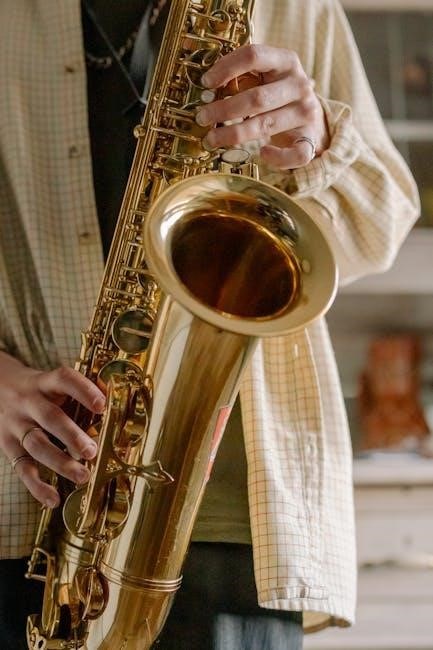
For jazz improvisation, the Jamey Aebersold Jazz Play-Along series incorporates fingerings within the context of jazz standards. These books often include PDFs with supplemental materials. Selecting a method book aligned with your learning style is crucial; Just as choosing the right library (like GSON) simplifies JSON parsing, a well-chosen book streamlines your saxophone journey. These resources build a strong foundation, extending beyond simple finger placement to musicality and expression.
Troubleshooting Common Fingering Issues
Like debugging JSON, addressing fingering problems requires precision. PDF charts help identify issues; sticky keys or poor coordination hinder progress, demanding focused practice.
Addressing Sticky Keys and Poor Response
Sticky keys significantly impede progress when utilizing a tenor saxophone finger chart PDF. Often, the issue isn’t the fingering itself, but mechanical problems with the instrument. Regular maintenance, including key oiling, is paramount. Just as escaping characters is vital in JSON formatting, proper instrument care is essential for smooth operation.
Poor response can stem from several factors. Ensure pads are sealing correctly; leaks cause notes to ‘cut out’ or sound airy. A PDF chart won’t solve a physical issue! Check for obstructions, and consider a professional overhaul if problems persist. Like structuring JSON responses for clarity, a well-maintained saxophone yields a clearer tone.
Furthermore, embouchure and breath support play a crucial role. Even with perfect fingering, inadequate air or incorrect mouth positioning will result in a weak or unresponsive sound. Consistent practice, alongside referencing your finger chart, is key to improvement. Remember, like JavaScript object notation, consistency is vital.
Improving Finger Dexterity and Coordination
Mastering a tenor saxophone finger chart PDF demands more than just knowing the positions; it requires significant finger dexterity and coordination. Think of it like parsing complex JSON data – it takes practice to become fluent. Start slowly, focusing on accuracy over speed. Utilize scales and arpeggios, referencing the chart frequently.
Exercises like chromatic scales and finger combinations build muscle memory. Just as minimizing JSON code improves efficiency, streamlined finger movements enhance playing speed. Avoid tension; relaxed hands are crucial. Consistent, short practice sessions are more effective than infrequent, lengthy ones.
Consider using a metronome to develop rhythmic precision. Coordination between fingers and breath control is also vital. Like the structured nature of JavaScript object notation, a methodical approach to practice yields the best results. Regularly review the finger chart to reinforce learning and identify areas for improvement.
Common Mistakes to Avoid When Learning Fingerings
When navigating a tenor saxophone finger chart PDF, several common pitfalls hinder progress. Many beginners rush, prioritizing speed over accuracy – akin to poorly formatted JSON, it creates errors. Avoid lifting fingers excessively; efficient movements are key. Don’t rely solely on memorization; continually reference the chart, especially initially.
Another mistake is neglecting proper hand position. A relaxed, curved hand facilitates smoother transitions. Ignoring alternate fingerings limits tonal possibilities, similar to restricting data types in a JavaScript object. Failing to practice slowly and consistently impedes muscle memory development.
Furthermore, overlooking the importance of breath support impacts tone and control. Like escaping special characters in JSON, attention to detail matters. Finally, don’t be afraid to seek guidance from a teacher; personalized feedback accelerates learning and corrects ingrained errors.