Bio-Rad’s innovative 7500 Fast Real-Time PCR System delivers rapid, reliable, and reproducible results, enhancing research and diagnostic workflows with advanced plate technology.
Overview of Real-Time PCR Technology
Real-Time PCR, also known as quantitative PCR (qPCR), is a powerful technique for amplifying and simultaneously quantifying a specific DNA or RNA target. Unlike traditional PCR, which measures product accumulation at the endpoint, real-time PCR monitors amplification during each cycle. This is achieved by incorporating fluorescent reporter molecules into the reaction.
As the target sequence is amplified, the fluorescent signal increases proportionally. The system detects this increasing fluorescence, allowing for precise quantification of the initial target amount. Two primary fluorescence detection chemistries are commonly used: SYBR Green, which binds to any double-stranded DNA, and probe-based assays, utilizing sequence-specific probes for higher specificity. This technology is crucial for gene expression analysis, pathogen detection, and genetic variation studies.
The 7500 System: Key Features and Benefits
The 7500 Fast Real-Time PCR System boasts several key features enhancing its performance. Its rapid thermal cycling capabilities significantly reduce run times, accelerating research and diagnostic throughput. The system supports a wide range of plate types, including standard 96-well and high-density 384-well formats, alongside Bio-Rad’s specialized Hard-Shell plates for optimal sealing and heat transfer.
Benefits include increased efficiency, improved data quality, and enhanced flexibility. The intuitive software simplifies experiment setup and data analysis. Furthermore, the system’s robust design ensures reliable and reproducible results. Compatibility with various chemistries, like SYBR Green and probe-based assays, broadens its application scope, making it a versatile tool for diverse molecular biology workflows;
Applications of the 7500 System in Research and Diagnostics
The 7500 Fast Real-Time PCR System serves a broad spectrum of applications within both research and clinical diagnostics. In research, it’s invaluable for gene expression analysis, quantifying nucleic acids, and validating microarray data. Researchers utilize it for studies in cancer biology, infectious disease, and drug discovery, benefiting from its speed and accuracy.
Diagnostic applications include pathogen detection, genetic disease screening, and personalized medicine. The system’s reliability and sensitivity make it ideal for clinical laboratories requiring precise and timely results. Its compatibility with diverse assays allows for the development of customized diagnostic tests. The use of Hard-Shell plates further enhances assay robustness, ensuring dependable performance in critical diagnostic settings.
System Components and Setup
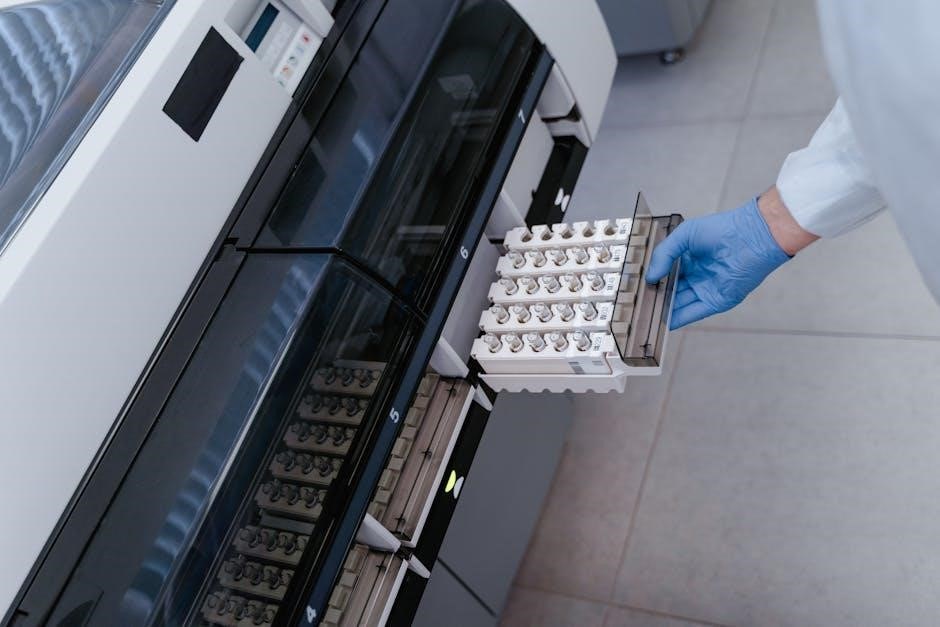
The 7500 System comprises a thermal cycler, a controlling computer, and essential peripherals, requiring careful installation and configuration for optimal performance.
Hardware Components: Thermal Cycler, Computer, and Peripherals
The 7500 Fast System’s core is the thermal cycler, engineered for rapid heating and cooling, significantly reducing PCR run times. This unit precisely controls temperature changes crucial for amplification. A dedicated computer, running specialized software, manages the cycler, data acquisition, and analysis.
Essential peripherals include a power cable, a communication cable (typically USB) for connecting the cycler to the computer, and potentially a barcode reader for sample tracking. The system also requires a standard monitor, keyboard, and mouse for user interaction. Proper ventilation is vital for the thermal cycler to maintain optimal operating temperature and prevent overheating. Ensure all connections are secure and the computer meets the minimum system requirements specified by Bio-Rad for seamless operation.
Software Installation and Configuration
Installing the 7500 Fast System software begins with inserting the provided installation media or downloading the latest version from Bio-Rad’s support website. Follow the on-screen prompts, accepting the license agreement and selecting the desired installation directory. During configuration, the software will guide you through connecting the thermal cycler to the computer, typically via USB.
User account creation and permission settings are crucial for data security and traceability. The software may require specific system drivers to function correctly; ensure these are installed. Post-installation, verify the connection between the software and the thermal cycler. Calibration settings and instrument-specific parameters are often automatically configured, but manual adjustments may be needed based on experimental requirements. Regularly check for software updates to benefit from bug fixes and new features.
Initial System Calibration and Verification
Prior to commencing experiments, the 7500 Fast System requires initial calibration and verification to ensure optimal performance and accurate results. Bio-Rad provides a dedicated calibration dye or kit for this purpose. The software guides users through a calibration protocol, typically involving running the dye across a temperature gradient.
This process establishes the system’s optical baseline and thermal uniformity. Following calibration, a verification run using a known positive control template is essential. This confirms the system’s ability to accurately detect and quantify target DNA. Review the verification results carefully; any deviations from expected values necessitate repeating the calibration process or contacting Bio-Rad support. Document all calibration and verification data for quality control purposes.

Plate Types and Compatibility
The 7500 system supports various plate formats, including standard 96-well, 384-well, and Bio-Rad’s specialized Hard-Shell PCR plates for optimal results.
Standard 96-Well PCR Plates
Standard 96-well PCR plates represent a widely utilized and versatile option for real-time PCR experiments on the 7500 system. These plates are compatible with a broad range of reagents and assay formats, making them suitable for diverse applications. They offer a balance between throughput and cost-effectiveness, ideal for initial assay development, validation, and routine gene expression analysis.
When using 96-well plates, ensure they are certified as PCR-clean and free from DNase and RNase contamination. Proper sealing with optical adhesive film or caps is crucial to prevent evaporation and cross-contamination during thermal cycling. The 7500 system’s optical design is optimized for reliable detection within these standard plate formats, delivering accurate and reproducible quantification data. Careful attention to plate quality and sealing is paramount for successful experiments.
384-Well PCR Plates
Utilizing 384-well PCR plates on the 7500 Fast System significantly increases throughput, enabling researchers to analyze a larger number of samples in a single run. This is particularly beneficial for high-density screening applications, such as drug discovery or large-scale genetic studies. However, working with 384-well plates requires meticulous attention to detail to ensure accurate and reliable results.
Proper plate sealing is even more critical with 384-well formats to prevent evaporation, which can lead to inaccurate quantification. The 7500 system is fully compatible with validated 384-well plates, offering optimized optical performance. Careful pipetting techniques and thorough mixing are essential to maintain assay precision. Consider reagent volumes and ensure they are appropriate for the smaller well volume to avoid pipetting errors and ensure consistent performance.
Hard-Shell PCR Plates: Advantages and Usage (Bio-Rad)
Bio-Rad’s Hard-Shell PCR plates represent a significant advancement in PCR consumables, designed to enhance thermal contact and minimize well-to-well variability. These plates feature a unique, ultra-thin-wall construction that facilitates rapid and uniform heat transfer, crucial for the fast cycling capabilities of the 7500 system. This improved thermal efficiency leads to more consistent amplification across all wells, resulting in higher data quality.
Hard-Shell plates are compatible with a broad range of PCR instruments, extending beyond Bio-Rad systems, offering versatility to laboratories. Their robust design minimizes warping and deformation during thermal cycling, ensuring reliable sealing and preventing sample loss. Utilizing these plates can improve assay reproducibility and sensitivity, particularly when working with challenging templates or multiplexed assays.
Reagent Selection and Preparation
Optimal reagent choices, including master mixes and carefully designed primers/probes, are essential for accurate and reliable results on the 7500 system.
Master Mixes: SYBR Green vs. Probe-Based Assays
Selecting the appropriate master mix is crucial for successful real-time PCR. SYBR Green assays are cost-effective and versatile, detecting any double-stranded DNA, but are prone to non-specific amplification and require melt curve analysis for verification. Probe-based assays, utilizing fluorescently labeled oligonucleotide probes, offer higher specificity as they only signal upon binding to the target sequence.
For the 7500 system, Bio-Rad offers optimized master mixes for both SYBR Green and probe-based chemistries. Probe-based assays, like TaqMan, minimize background and allow for multiplexing, enabling the simultaneous detection of multiple targets in a single reaction. Consider the experimental goals, budget, and required specificity when choosing between these two powerful detection methods.
Primer and Probe Design Considerations
Effective primer and probe design is paramount for accurate and reliable results with the 7500 system. Primers should be 18-25 nucleotides long, possess a GC content of 40-60%, and exhibit similar melting temperatures (Tm) to ensure efficient amplification. Avoid self-complementarity, hairpin structures, and runs of the same nucleotide to prevent primer-dimer formation.
For probe-based assays, probes should be designed to bind within the amplicon, ideally between the primers. Ensure probes have minimal secondary structure and a Tm 5-10°C higher than the primers. Utilize validated design tools and thoroughly check for potential off-target binding sites. Proper design minimizes non-specific amplification and maximizes signal-to-noise ratio, crucial for quantitative analysis.
Water Quality and Reagent Handling
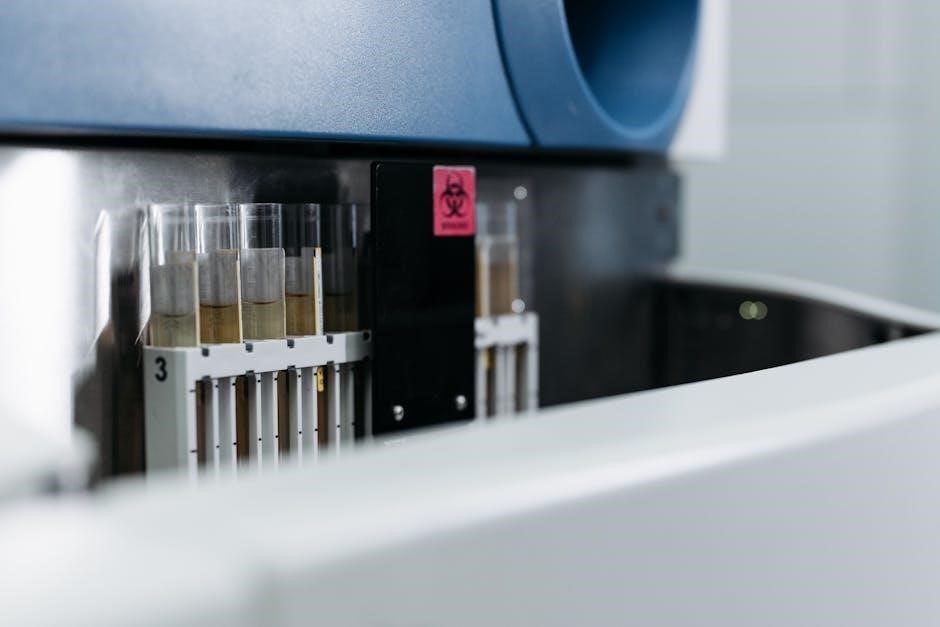
Maintaining optimal water quality is critical for successful real-time PCR. Utilize nuclease-free water, specifically prepared for molecular biology applications, to prevent DNA degradation and ensure accurate results. Avoid using tap water or distilled water not specifically treated for PCR.
Reagent handling requires meticulous attention to detail. Store reagents according to manufacturer’s instructions, minimizing freeze-thaw cycles. Always use dedicated pipettes and filter tips to prevent cross-contamination; Prepare master mixes carefully, ensuring thorough mixing. Aliquot reagents to avoid repeated access to stock solutions. Proper handling safeguards reagent integrity and minimizes errors, leading to reliable quantification.

Experimental Design and Run Setup
Careful planning is essential for robust data. Define sample sizes, replicates, and thermal cycling parameters, then configure detection settings for optimal performance.
Defining Experimental Parameters: Sample Size, Replicates
Establishing appropriate experimental parameters is crucial for statistically significant and reliable results. Sample size directly impacts the power of your study – larger sizes generally yield more robust conclusions, but consider budgetary and sample availability constraints.
Replicates are essential for assessing experimental variability and minimizing the impact of random errors. Technical replicates involve multiple PCR runs of the same sample, while biological replicates utilize independent samples from different sources. Aim for at least triplicate technical replicates and a sufficient number of biological replicates (typically three or more) to ensure data accuracy and representativeness.
Proper replication allows for meaningful statistical analysis, enabling you to confidently determine if observed differences are genuine or due to chance. Carefully consider the expected effect size and desired statistical power when determining the optimal number of replicates for your specific experiment.
Setting Up the Thermal Cycling Protocol
The 7500 Fast System excels with rapid thermal cycling, significantly reducing PCR run times. A typical protocol includes initial denaturation, cycling steps (denaturation, annealing, extension), and a final hold. Initial denaturation activates the polymerase, while each cycle amplifies the target sequence.
Optimize annealing and extension temperatures based on primer characteristics and amplicon length. Faster cycling requires careful optimization to maintain specificity and efficiency. Utilize the system software to program precise temperature control and duration for each step.
Consider a gradient PCR to determine optimal annealing temperature if unsure. The software allows for customized protocols, accommodating diverse assay requirements. Accurate protocol setup is paramount for successful amplification and reliable quantification.
Defining Detection Parameters: Reporter and Quencher Dyes
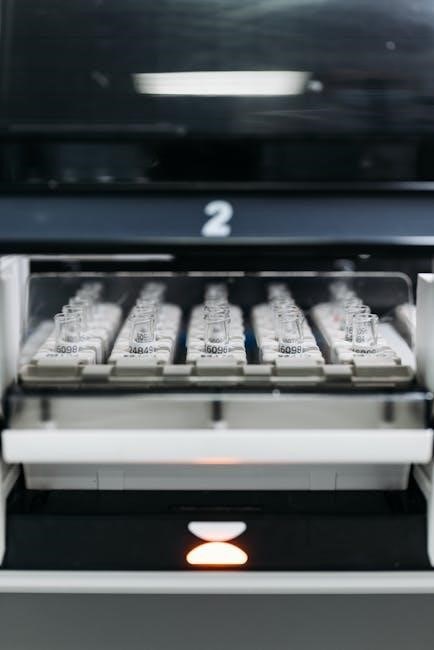
Real-time PCR relies on fluorescent signals to monitor amplification. Reporter dyes bind to the amplified product, increasing fluorescence. Common reporters include FAM, VIC, and others, each emitting at a specific wavelength.
Quencher dyes suppress the reporter’s signal when the probe is intact. During amplification, probe cleavage releases the reporter, increasing fluorescence detected by the 7500 system. Proper dye selection is crucial for multiplex assays, avoiding spectral overlap.
The system software allows defining reporter/quencher combinations for each assay. Accurate dye assignment ensures correct data interpretation. Optimize dye concentrations for optimal signal-to-noise ratio and reliable quantification of target sequences.
Data Acquisition and Analysis
The 7500 system captures fluorescence data during each PCR cycle, generating amplification curves crucial for downstream analysis and accurate quantification results.
Real-Time PCR Data Output Formats
The 7500 Fast System software provides versatile data output options to facilitate comprehensive analysis and reporting. Primary output includes the .xls format, enabling easy import into spreadsheet programs like Microsoft Excel for custom calculations and graphing. Additionally, data can be exported as .txt files, suitable for compatibility with various statistical software packages.

For advanced analysis, the software supports export to .sdn format, Bio-Rad’s standard data file, which preserves all raw data and experimental parameters. This format is ideal for sharing data with collaborators or utilizing Bio-Rad’s specialized analysis tools. Furthermore, the system generates comprehensive reports in PDF format, summarizing key results, amplification curves, and statistical analyses, streamlining data presentation and documentation.
Baseline Correction and Threshold Setting
Accurate quantification in real-time PCR relies heavily on proper baseline correction and threshold setting within the 7500 software. Baseline correction automatically subtracts background fluorescence, ensuring accurate Ct value determination. The software offers both automatic and manual baseline adjustment options, allowing optimization for varying experimental conditions.
Threshold setting defines the fluorescence level at which amplification is considered significant. It’s crucial to set the threshold within the exponential phase of amplification curves, consistently across all samples. The software provides tools for visual threshold adjustment and displays amplification curves to aid in precise placement. Proper baseline and threshold settings minimize variability and enhance the reliability of quantitative results, ensuring data integrity.
Ct Value Determination and Quantification
The Ct (Cycle threshold) value, determined by the 7500 system software, represents the number of PCR cycles required for the fluorescent signal to cross a defined threshold. This value is inversely proportional to the initial template quantity; lower Ct values indicate higher starting amounts of target DNA.
Quantification methods include absolute quantification, using a standard curve generated from known concentrations, and relative quantification, comparing gene expression levels between samples. The software facilitates both approaches, performing calculations based on user-defined parameters. Accurate Ct value determination is vital for reliable quantification, and proper baseline correction and threshold settings are essential prerequisites. Data analysis tools within the software enable efficient and precise quantification of target sequences.

Troubleshooting Common Issues
Addressing issues like weak signals, high background noise, or primer-dimer formation is crucial for optimal 7500 system performance and accurate, reliable results.
No Amplification or Weak Signal
Several factors can contribute to the absence of amplification or a weak signal in real-time PCR. First, verify the integrity of your RNA or DNA template; degradation significantly impacts results. Ensure proper primer design, checking for specificity, self-complementarity, and appropriate annealing temperatures. Confirm sufficient template concentration is used, as too little template may not be detectable.
Next, meticulously review the master mix components, ensuring correct reagent concentrations and proper storage. Check the functionality of the reporter dye and quencher, and confirm the thermal cycling protocol is optimized for your target sequence. Finally, examine the optical system of the 7500 instrument, ensuring the detector is clean and functioning correctly. A failed or improperly set up control reaction can also lead to these issues.
High Background Noise
Elevated background noise in real-time PCR can obscure true signals and compromise quantification accuracy. Common causes include contamination from exogenous DNA or RNA, often introduced during reagent preparation or sample handling. Ensure strict adherence to sterile techniques and dedicated workspaces. Primer-dimer formation, resulting from primers annealing to each other, also contributes significantly to background.
Optimize primer design to minimize self-complementarity and consider using a hot-start polymerase to prevent non-specific amplification. Check the quality of your water; contaminants can dramatically increase background. Furthermore, ensure proper calibration of the 7500 system’s optical components and verify the correct selection of reporter and quencher dyes. Finally, assess the plate for fingerprints or dust, as these can interfere with signal detection.
Melt Curve Analysis and Primer-Dimer Detection
Melt curve analysis is a crucial post-PCR step for verifying amplification specificity and detecting primer-dimers. This process involves gradually increasing the temperature of the PCR product while continuously monitoring fluorescence. A single, sharp melting peak indicates a homogenous, specific product. Multiple peaks or broadened peaks suggest non-specific amplification or the presence of primer-dimers.
The 7500 system’s software automatically generates melt curves. Primer-dimers typically melt at lower temperatures than the intended amplicon, appearing as a distinct peak on the curve. If primer-dimers are detected, redesign primers to reduce self-complementarity or optimize annealing temperatures. Consider increasing the primer concentration or using a hot-start polymerase to minimize non-specific amplification. Careful melt curve analysis ensures data reliability.

Maintenance and Cleaning Procedures
Regular cleaning of the thermal cycler and software updates are vital for optimal performance and longevity of the 7500 Fast System.
Routine Cleaning of the Thermal Cycler
To maintain optimal performance, the 7500 Fast Real-Time PCR System’s thermal cycler requires regular cleaning. After each use, carefully inspect and wipe down the sample block with a soft, lint-free cloth dampened with 70% ethanol. Ensure all spills are immediately addressed to prevent corrosion or interference with subsequent runs.
Periodically, the interior surfaces of the thermal cycler should be cleaned. Power off the instrument and disconnect it from the power source before commencing. Use a mild detergent solution and a soft cloth to gently clean the interior surfaces, avoiding any harsh chemicals or abrasive materials. Thoroughly dry all components before restoring power. Regular cleaning prevents buildup and ensures accurate temperature control, contributing to reliable results.
Software Updates and System Diagnostics
Maintaining the 7500 System software up-to-date is crucial for optimal performance and access to the latest features. Regularly check Bio-Rad’s website for available software updates and follow the provided installation instructions carefully. Updates often include bug fixes, improved algorithms, and enhanced compatibility.
The 7500 software incorporates built-in diagnostic tools to monitor system health. Utilize these diagnostics periodically to assess the functionality of key components, such as the thermal cycler and optical system. These tests can identify potential issues before they impact experimental results. Review diagnostic reports for any error messages and consult the system manual or Bio-Rad support for troubleshooting guidance. Proactive diagnostics ensure reliable operation.
Recommended Preventative Maintenance Schedule
To ensure long-term reliability and accuracy of the 7500 System, adhere to a consistent preventative maintenance schedule. Daily, visually inspect the instrument for any physical damage and clean the exterior surfaces. Weekly, perform a thorough cleaning of the thermal cycler block, following the procedures outlined in the system manual.
Monthly, run the built-in system diagnostics to verify proper functionality of all components. Every six months, consider a professional preventative maintenance service performed by a qualified Bio-Rad technician. This service includes a comprehensive inspection, calibration, and replacement of worn parts. Maintaining this schedule minimizes downtime and maximizes the lifespan of your investment, guaranteeing consistent, high-quality results.